


Our Annotated Commentary to the Worst Piece of Journalism 2018
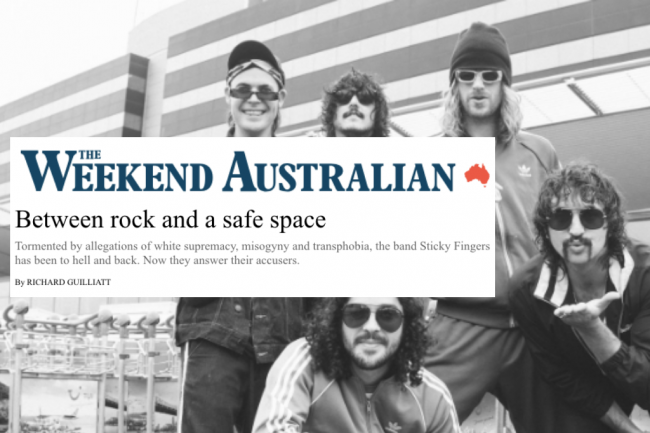
Between rock and a safe space
[To suggest that rock is diametrically opposed to safe spaces is abhorrent. Already the author is twisting music to their own political agenda, which, as you will see, is some kind of white heterormative male hegemony of rock.]
Tormented by allegations of white supremacy, misogyny and transphobia, the band Sticky Fingers has been to hell and back. Now they answer their accusers.
[Tormented. Okay, sure.]
[Yeah, ha – not like their detractors haven’t also been through the ringer!]
By RICHARD GUILLIATT
[Who is this man and what is his connection to the culture of music?]
Not so long ago, Sticky Fingers was the most popular rock’n’roll band in the country. In 2015, the Sydney five-¬piece sold out a tour of Australia without even bothering to announce it; the following year their third album, Westway (The Glitter & The Slums), debuted at No.1 on iTunes and their seven-month world tour traversed three continents. But that was before the transgender rapper Miss Blanks accused them of white supremacy, misogyny, sexism and transphobia; before indigenous activists began inciting people to disrupt their concerts and harass them on social media; before the columnist Clementine Ford declared that they engaged in “sexual degradation and humiliation” of women.
[Miss Blanks (Sian Vandermuelen) has called out this band In the past, but to suggest that it started with her would be misleading. Hearsay and conjecture about the group’s poor behaviour behind music industry scenes has been circling at least as far back as 2013, when Dylan Frost was reportedly arrested by Western Australian police after climbing the rafters backstage at an event called Rottofest. After a scuffle with event security concerned with the safety of the crowd, he was handed over to local police. Some of these whispers concerned alleged poor behaviour at Splendour in the Grass the following year. Now to emphasize, no one has gone on the public record to confirm this as fact so some of this may not be true. But then they haven’t been invited back. There were other incidences of poor behaviour earlier on, but the author gets on to those later, so let’s continue.]
Today the radio station that helped launch Sticky Fingers, the ABC’s Triple J, barely plays their music, and the call to boycott them has been joined by a swelling chorus of activists and music industry figures. Sally Rugg, executive director of change.org, accuses the band of “routinely” abusing indigenous and gay women. Punk drummer Sarah Thompson has labelled them “pathetic, abusive, racist, misogynistic, transphobic pieces of shit”. Music festivals that hire them face protests, petitions and cancellation threats
from other artists.
[triple j have not played the group since April period. To the best of our knowledge there has only been a single festival to date which they have been forced to withdraw from, This That.]
It has been a whiplash change of fortunes, made more acute by the fact that Sticky Fingers sprang from Sydney’s most politically Left locale, Newtown Camperdown, a hub of alt-lifestyle activism that the band celebrated in song.
[Not sure what the author is driving out here. It’s not exactly like they’ve been extolling leftist values in their lyrics, which tend to circle mostly around the topics of drugs, alcohol and fucking.]
Today it’s a base of operations that can feel like hostile territory. “This was an area where we always felt comfortable,” says their moustachioed keyboard player Crabz — known to his mum as Daniel Neurath — as he sits in a cafe near their manager’s office. “To walk around feeling that you’re being looked at or talked about, that you’re viewed as these reprehensible characters… it’s weird.”
[Can you think of a reason why, Dan?]
Like his band-mates, Crabz expresses bewilderment at the allegations levelled against them. In the band’s account, a swirl of half-¬truths and outright fabrications on social media became an online mobbing by amateur journalists and misguided activists who’ve paid little heed to the harm their vilification has wrought, in particular to the band’s troubled lead singer, Dylan Frost. How a band that has worked closely with the indigenous community came to be labelled racist is indeed a puzzle, one that some of their most vehement critics are surprisingly reluctant to discuss when asked to produce the evidence. What’s clear is that Sticky Fingers have found themselves at the pointy end of a sudden cultural shift in the music business, an industry whose long history of outrage and excess is now undergoing a moral stocktake at the hands of a younger “woke” generation.
[Already the author casts detractors of the band in a dismissive light. Media voices speaking poorly of the group are varied ranging from music critics, professional journalists, feminist commentators, radio broadcasters, representatives of triple j, fans and community leaders. Wasn’t he just talking about Clementine Ford just a second ago?]
In January the indie rock performer Kirin J. Callinan was banned from the Laneway Festival in Melbourne after flashing his penis from under a kilt at the ARIA Awards.
[Incorrect. Callinan was banned from performing at all Laneway shows after his exposure in public, incorrectly stated by some to be in the proximity to young children, raised concern online and was brought to attention to the festival directors by Safe Space Ambassador Miss Blanks.]
In June a tour by the US rapper Riff Raff was cancelled after a Melbourne woman alleged on Facebook that he’d raped her five years earlier in his hotel room, an accusation he denied.
[Relevance? Sticky Fingers have not been saddled with any substantive accusations of sexually motivated assault or rape.]
More recently there have been calls to boycott the popular Brisbane punk trio Dune Rats over unsubstantiated claims about their treatment of female fans.
[That may have been us. Whoops!]
One music website, Pilerats, is compiling a blacklist of performers whose behaviour it considers unacceptable. Music festival promoters face mounting attacks over the gender balance of their shows and the inclusion of performers deemed to be offensive — a phenomenon not confined to the music industry, as Brisbane Writers’ Festival showed when it disinvited the feminist Germaine Greer because of her controversial views on sexual assault.
[A music industry increasingly led by consumer taste? Who would have figured? No serious objections here.]
Some music business veterans sound disoriented by this insurrection from a younger demographic who talk of rock concerts as “safe spaces”. “Yeah, I dunno… what would happen if Jimmy and the Boys were still playing?” remarks veteran concert promoter Michael Chugg, referring to the infamous 1970s band who simulated sadomasochism and rape onstage.
[Here’s a hypothetical scenario: People wouldn’t like it. Sidenote: Barnes was still using the word ‘negro’ to refer to Black Americans during the 1990s. As for ‘Safe Spaces’? Advocates young and old talk about concerts as safe spaces because they want them to be safe spaces. People are now being arrested for grabbing women’s asses, breasts and genitals without consent. It’s sexual assault, for Christ’s sake! If you’re finding that a little too baffling, perhaps consider that you might need to get a grip.]
[Or, you know, maybe actually go chat and listen to some folks that are under 22.]
Sydney promoter Matt Rule, whose business was attacked on Facebook in March after Sticky Fingers headlined its Bad Friday concert, is among those who see a darker side to this talk of boycotts and blacklists. “There’s no one I know who isn’t supportive of change in the industry,” says Rule. “But what I’m seeing is people who think they’re doing the right thing threatening to ruin or discredit your good name by labelling you as an apologist and threatening to campaign against you. It’s completely misguided.”
[Music is driven by the fickle currents of taste. If you’re expecting a more consistent industry climate, perhaps consider moving to another profession?]
For Sticky Fingers, who played a sold-out world tour in June and have a new album awaiting release, the long-term career damage is unclear but the personal fallout has been serious.
[Many who have spoken critically of this article on social media have expressed that they find it difficult to sympathise with such statements, claiming that the band are using it as an excuse to avoid accepting the consequences of their allegedly poor behaviour.]
[So of course, Mr. Guilliatt didn’t interview anyone with an opposing view for his article!]
In early July, as the campaign against the band reached a crescendo, singer Dylan Frost was admitted to hospital after an episode of self-harm he declines to discuss in detail. He attributes the incident to “a war in my own head” he has been fighting for years — since 2015 he has been diagnosed with multiple psychiatric disorders, leaving him struggling to find the right treatment. Frost says he’s now recovering and looking forward to working again, but some in the industry wonder where this new form of activism as public humiliation is heading.
[Absent here is an examination of the music industry’s poor track record when it comes to taking care of artists’ mental health.]
“It stinks, to be honest,” says one promoter. “People who crow from the rooftops about being interested in welfare are abusing people with mental health issues without seeming to think about the potential consequences. It’s dangerous.”
[As iterated earlier, many who have spoken critically of the group on social media articulate a feeling that mental health is used to deflect accountability for the band’s behaviour. It is unclear with Frost has or had diminished responsibility on account of his illness.]
“Reminiscing on the days when we used to have a blaze,
Everybody came around and we laxed out on the laze,
And I remember when we’d drink and we’d smoke and we’d spar and we’d laugh,
And the night would just go on and on…”
Australia Street by Sticky Fingers
[Remember the author’s earlier implication that the group were left-leaning Newtown aesthetes?]
Sticky Fingers never put much effort into making friends in the music business or honing their hipster credentials. Teenagers when they got together in Sydney’s inner west 10 years ago, the band took their name from a decades-old Rolling Stones album and built an audience the old-fashioned way, by touring relentlessly.
[Most bands, actually, but the way this guy talks you’d think they were the last.]
[Also, I wouldn’t knock friends – organic connections among fellow musos can lead to cool bills, collaborative projects, and, if they’re actual friends, genuine critics who can confront you in private before you royally screw something up.]
Their sound was a light-footed mix of reggae and Britpop singalong, and their visual aesthetic mixed mullet haircuts, porn-star moustaches, tracky-dacks and footy shorts into a semi-ironic bogan chic.
[A fairly succinct summary of what they’re all about. But let’s face it, a band with little critical acclaim and massive popularity amongst fans? It’s nothing new.]
Record companies ignored them and the ARIA Awards has forever snubbed them, but their energy lit up venues and in Dylan Frost they were fronted by a natural star, a shaggy-haired waif with a tattooed torso and an irresistible melodic lilt in his voice.
Born in New Zealand in 1991, Frost could tear up a stage, yet remained an enigma away from it, paralysed with self-consciousness in the rare interviews he granted. His raffish grin concealed a volatility that became more visible as the band’s workload and offstage habits took their toll. In 2013 he was arrested after a stoush with security at a concert in WA and thrown in a paddy wagon while tripping on hallucinogens in Queensland; the following year he was given a suspended jail sentence for driving drunk and without a licence, and the whole group was banned from a NSW country pub over allegations they abused staff and urinated on a balcony. In the music press it was largely celebrated as bad-boy hijinks, and the band obliged by sharing videos of their hotel-trashing exploits and tour diaries detailing their drug and alcohol-fuelled escapades. But those closer to the band saw where it might lead.
[Many have taken this as probative evidence to support more recent allegations of poor behaviour. The group have behaved poorly in past; they’ve created an inclination within many individuals to accept allegations of racial abuse even if they are true or not. Can you blame them?]
[The writer doesn’t include that he had been disqualified from driving previously for 12 months and fined $400 after he was convicted of mid-range drink driving in 2007.]
“Dylan has demons,” says one person who worked with Sticky Fingers for years. “He has mental health issues that make him not socially able, and he has massive aggression issues with alcohol. But he’s spent his whole adult life in an industry that celebrates drug and alcohol excess.”
[It seems that those surrounding the artists are never shy on chiming on with remarks like this but sadly few if any seem to believe the issue should actually be addressed.]
[Well, actually, they’re a little bit shy, because they didn’t want their name published in the article. This is the second person so far who chose to remain anonymous – which isn’t entirely the writer’s fault, but it does make you wonder who he selected for his pull quotes.]
The unravelling began in 2015 when bass player Paddy Cornwall checked himself into a psychiatric clinic in Thailand, while Frost entered treatment for substance abuse and was assessed as suffering bipolar disorder with possible schizophrenia, a diagnosis he never really accepted. “At the time I was sure I didn’t believe that was what I had,” he says, responding to questions by email. The diagnosis wasn’t mentioned when the band re-emerged in 2016, ostensibly recharged, for a seven-month world tour.
[Does he, or doesn’t he? Obviously, it’s a hard thing to work through but it leaves little wonder why critics aren’t’ entirely receptive for the use of nebulous metal illness as justification for all of Dylan’s alleged misdeeds.]
[Yeah, no shit. I also love the how the author phrases this in a way that favours Frost’s doubt, like he doesn’t even think it’s real!]
Their third album was a hit and global success was beckoning when, during a mid-year respite from touring, Frost was involved in a minor commotion that kickstarted the snowballing campaign that now engulfs them. The event was a gig at the Red Rattler Theatre in Marrickville, Sydney by the indigenous band Dispossessed, an outfit so militant they regard white audiences as oppressors “even when you stand in front of us clapping”. Frost was in the audience at the invitation of the band’s then leader, Birrugan Dunn-Velasco, but the crowd reacted with such hostility to their hectoring speeches that the performance ended after two songs. The following day, Dunn-Velasco took to Facebook and accused the crowd of “microaggressions of colonial violence”, singling out Frost for “grossly shirt-fronting us”.
The “shirt-fronting” charge was rhetorical: no violence occurred on the night and the band’s own video of the event shows Frost doing nothing more than telling Dispossessed he has “the greatest respect” for them. One eyewitness, Taylor Cawsey, confirmed to this magazine that Frost said nothing offensive, and Frost himself — a Maori who has marched alongside indigenous activists at political rallies — avows that he abhors racism. But in July 2016, when the brouhaha erupted, he stayed characteristically silent and let his bandmates issue denials.
[Accounts differ. The footage is of a poor quality and reveals little. One rumour attributes the alleged actions to Frost’s girlfriend. Also, are we to take the band at face value? It’s difficult not knowing all the facts.]
[Also – who was Taylor Cawsey? Probably not an unbiased eyewitness. Did the author not try and contact anyone in Dispossessed? He says in the end that he tried to reach Denn-Velasco, but not anyone else. Gotta love how he casts rebellious minorities as the “militant” enemy!]
[A quick google search returns a LinkedIn account that shows that Taylor Cawsey interned for Sureshaker between May and October 2017. Who are Sureshaker? Well, according to their website “A music company. Home to Sticky Fingers“.]
Then, five months later, the 21-year old indigenous pop performer Thelma Plum made a far more explosive accusation.
The drama again played out on social media, where Plum has built a 40,000-plus following for her outspoken commentary on everything from intersectional feminism to the semi-comic travails of being a “drama queen”. In December 2016 she posted an angry tirade on Facebook accusing Frost of drunkenly abusing her and her boyfriend outside a Sydney hotel, describing it as a terrifying late-night fracas in which Frost spat at her and swung punches that nearly hit her. Plum added that his mistreatment of women was well known and claimed there was video evidence of him racially abusing Dispossessed five months earlier.
[This is the core of what many find offensive about the whole Sticky Fingers kafuffle. The allegation that Dylan spat on an indigenous – First Nations – woman is a difficult contention to ignore.]
Those allegations later disappeared from Facebook after Plum suffered merciless online abuse from Sticky Fingers fans, and her description of the pub altercation was quickly contradicted by an eyewitness, Paige Moore, a friend of Frost’s who insisted he never swung a punch, spat at or came physically close to Plum. But by the time Moore’s account appeared — also on Facebook — the allegations of racial abuse and violence had gone viral on multiple music media sites and social media feeds.
[People remember the same events differently. Eye witness evidence is often of little use in courts of law and perhaps it is here as well. Furthermore are we supposed to take the word of a friend of the group over a potential victim? Plum has stated elsewhere that she took down the post after her and the Dylan resolved the matter privately. It’s also relevant to note that the band’s representatives also sent cease and desist orders to a number of music publications reporting on the matter. As a result, many articles were taken down.]
[Paige Moore’s statement implies that she wasn’t there at the start of whatever happened so does it really count as a contradiction to Plum’s description of what happened?]
Disastrously, Sticky Fingers chose this moment to announce an indefinite hiatus due to unspecified “internal problems”, without actually denying any of Plum’s allegations.
[Likely a calculated move to lay low until the bad publicity has subsided. It didn’t exactly work did it?]
[To me, this was where they lost it. I truly think they could have achieved redemption. Going on indefinite hiatus when they did and in the way they did made it feel like they were just running away from their problems because it was the easy option. The post-hiatus anger came because of the arrogance of the comeback, with no mention of why they went on hiatus. Just a “We’re back!!!”. If they meant it, if they were serious, they really needed to have started their comeback months before by talking about what had happened and what they had done about it. I think there could have been some sympathy from the music press if they showed some sign of taking ownership for their actions, showing remorse, of growing up, of trying to be better people. But they blew it and have made it worse by painting themselves as the real victims. Someone should have given them better advice.]
“It brought us no pleasure seeing the attacks on her and our feeling was that responding would just worsen the bullying,” says Crabz, who insists the hiatus was mainly prompted by the band’s exhaustion after years of touring. But the perception that they weren’t actually denying Plum’s claims was reinforced when Frost released a statement saying he was “incredibly sorry” for hurting people around him, revealing his alcohol addiction and mental health problems but failing to deny the specific allegations. Thousands of the band’s fans logged supportive posts on their Facebook page, but music websites that had once cheerfully promoted Sticky Fingers now turned on them. Joe Earp, editor of The Brag, tweeted: “Sticky Fingers, the famous racist band, have announced they’re too racist to continue.” Pilerats editor Troy Mutton announced he was blacklisting the band. Others — Tone Deaf, Pedestrian TV, MusicFeeds — would pile on later.
[Pile on? This was no conspiracy nor was their collusion. They were reporting on a broader conversation happening amongst Australian music fans. All the while the mainstream media remained silent.]
[Yeah, I love how the author berates blogs for actually being morally responsible about what they choose to cover and not cover!]
[If I remember correctly, there is also a music website who blacklisted them a long time ago, long before the events of the last 18 months, because of how the band treated a female music writer when she interviewed them.]
One person who was appalled by the racism accusations was Hetti Perkins, daughter of indigenous activist Charles Perkins, whose son Tyson had filmed many of Sticky Fingers’ videos and who had known the band almost from the beginning. “I reached out privately to some of the people directly involved who were attacking the band on social media following the Dispossessed gig,” Perkins recalls. “Knowing the band, I felt that there must have been a misunderstanding — they work with my son and other blackfellas, they’d participated in marches, they’ve done workshops with Koori kids, they’ve got Koori mates like our family. But I got publicly labelled a white apologist and ‘Aunt Jemima’ and it became clear that people weren’t interested in having a dialogue.”
[Racism is insidious. Again, it depends upon facts, which we don’t have.]
In February 2017, Sticky Fingers finished their touring commitments with a gig at the Party In The Paddock festival in Tasmania, then headed back to Sydney. The plan was to recuperate and put the dramas of the previous year behind them. What they hadn’t counted on was a scandal already brewing
across the other side of the Pacific involving the Hollywood producer Harvey Weinstein.
[How did we get this far before mentioning #MeToo? But also note that a number of bands and industry figures had been called out for sexually motivated abuse well before #METOO had taken shape. In 2016 Swans’ Micheal Gira was accused of rape, and prominent industry publicist Heathcliff Berru was also outed for a far-reaching history of sexual assault. A high-profile boycott of US group PWR BTTM occurred in ’17.]
[Yep! PWR BTTM were dropped like stones! And to my knowledge, no one has tried to write any apologetic investigation for them.]
When Kirin J. Callinan turned up at last year’s ARIA Awards wearing a tartan skirt, sans underwear, he wasn’t necessarily aiming to cause a national commotion.
[Admittedly we have enjoyed some of Callinan’s work in past but notwithstanding are opposed to men exposing their genitals. Also, isn’t this supposed to be an article about Sticky Fingers? What is the relevance? It seems to be loosely if at all analogous.]
[I read this and was immediately like, what is Callinan’s dick doing here? Apologize for one dude at a time, OK? I reckon the author’s taking a wide view of the cultural current post-Weinstein, but…yeah.]
For much of his career as a pop provocateur, Callinan has toyed with the masculine conventions of rock’n’roll: last year he conducted an entire on-camera interview with SBS television wearing only a beret, and his most recent album, Bravado, features a full-frontal nude shot of him on a sofa, painted bronze. So when Callinan stopped to pose in the ARIAs’ media area outside Star City Casino, several photographers naturally asked what was concealed under his kilt. At which point, he obligingly showed them.
[You mean to say actions have consequences now? During this time he was working with a major record label to market his image to a mass audience. Did he not foresee a higher and more conservative level of public scrutiny? Clearly, he doesn’t know what he’s doing.]
[Yeah, I love how he frames this as if it’s the photographers’ fault for asking silly questions. Isn’t that what they’re paid to do, as part of the press?]
“I’d done lots of nude photo shoots before and I guess I was in that mood,” Callinan recalls of his split-second tackle-flashing, which he now admits was a stupid lapse. “My spirit about these things has always been pretty punk.” But this was November 2017, a month after the Harvey Weinstein rape scandal had ignited the #MeToo movement, and the social climate on such matters was very far from punk.
[Punk’s message was and will always be one of empowerment, particularly that of women. Again, genre serves as nothing more than a vehicle to further the author’s own personal preference for male privilege.]
[I’d add that punk is empowerment for an oppressed or wronged party, against an oppressor or overruling majority. But otherwise- correct! I read this and was like, OK, so you don’t question the man’s notion of punk, which is acting stupid and letting another dick dominate the conversation. But women rebelling against those dicks? No, that’s not fun anymore! Ugh.]
Women took to social media to denounce him; Pedestrian TV wrongly reported that he had flashed his penis “for a solid couple of seconds”; a Sydney music producer falsely claimed Callinan had exposed himself to children; journalists from SBS and Mamamia called his actions deplorable, toxic and close to sexual assault. Soon the online music journalist Shaad D’Souza added racism to the charges, describing Callinan’s bronzed nude spread as “blackface”. That accusation was taken up by transgender Samoan-Australian rapper Miss Blanks, who accused Callinan of “normalising racism, ableism and sexual assault”.
[It’s a live question. But again, weren’t we talking about Sticky Fingers?]
[We are, but I did find this section irresponsible too, that the author would just dismiss the concerns of offended people of colour. I reckon he’s trying to draw a parallel to Sticky Fingers, and Frost in particular.]
Miss Blanks — whose Twitter feed features graphic descriptions of her sex life alongside insulting remarks about “disgusting” white feminists and “old white women” — was the “safe space” ambassador for the Laneway music festival in Melbourne, where she and Callinan were both scheduled to appear. She lobbied Laneway to drop him, and within weeks they complied; in February police charged him with obscene exposure.
[The writer’s contempt for Blanks is so thinly veiled it begs the question why he didn’t just come right out and say it outright.]
[Ha, right. Like yeah, naked white dudes is fine, but chicks getting nasty on Twitter? NOPE]
Today Callinan says his guilty plea and good behaviour bond were less troubling than the “outright lies” about him that spread from social media to the queer and indigenous communities he has always embraced. “I read one online comment about myself that said: ‘This guy has his own history of shitty behaviour‘,” he recalls. “What does that mean? Half my family on my mother’s side are indigenous; so many of my nearest and dearest identify as gay or lesbian or trans. To be accused publicly of things you have stood against your whole life is hard to take.”
[Prevalent theme: disturbing belief that racial heritage can somehow preclude accountability for actions which might be interpreted as oppressive to women or others sharing similar racial heritage. If you’re stating, “I Can’t be racist because…”,maybe it’s time for a reality check.]
Callinan is now preparing to release a new album, uncertain whether he faces future boycott calls. But the storm over his kilt-flash was merely a prelude to the fury that erupted after Sticky Fingers emerged from hibernation in March this year to announce a surprise concert in Sydney.
[It was cancelled by local authorities due to a ‘gun threat’ after which one of the group’s fathers made less than congenial remarks against media publication Music Feeds. During this time Paddy also engaged in a Instagram feud with Thelma Plum after Plum accused Paddy’s partner of ‘infiltrating’ a feminist group for victims of abuse.]
Over the previous year, Dylan Frost had undergone three months of drug rehab and received a new diagnosis — borderline personality disorder — and a new medication that still did not resolve his issues. Bass player Paddy Cornwall had spent two and a half weeks in a Sydney psychiatric clinic, emerging with a diagnosis of bipolar.
[First time anyone’s reported this.]
Maintaining a low profile, the band had occupied themselves with holidays, songwriting, recording, and side projects such as a trip to Moree in NSW, where they helped build a recording studio for indigenous youths. “We’d recorded an album fully sober, and we were feeling really good,” Crabz recalls. “This was an example of a new, reformed band, in our view, and we were excited to say, ‘We’re back!’”
[Also news to us. Could they have made this more widely known at the outset of their return?]
What ensued was “a bit of a shock”. Three hours before their comeback concert in Sydney, the indigenous rapper and activist Felon Mason issued a Facebook message describing the band as“dogs” and inviting his followers to go to the gig and “shout em off stage. Or even better, someone deal out some proper punishment…” On chat sites and music industry Facebook feeds, meanwhile, unsubstantiated claims circulated that Frost had been involved in domestic violence, an allegation that had already appeared on the band’s own website from people who claimed to know of court proceedings. That accusation is false, says Frost. “There has never been an AVO taken out against me by anyone,” he says. “I’ve been fed up with people making false allegations against me. If anyone has legitimate claims against me, or the rest of the band for that matter, then go to the appropriate authorities and we’ll be held accountable.”
[Not to suggest that any of these are true. There is nothing to substantiate them. But that said, most instances of domestic violence go unreported.]
[Also, a thing I always think about when people try to defend people accused of abuse – quite a few men in the industry have no such rumours against their name! I’d like to think that most people don’t make such accusations lightly – they’re grounded in something.]
Hoping to reset the publicity, and with a world tour pending, the band cajoled Frost into joining them on Triple J’s Hack program in mid-May for an interview that would become their second PR debacle. Questioned about Thelma Plum and Dispossessed, Frost struggled to express himself and fell back on the opaque language of his prepared statements. His bandmates, meanwhile, spoke frankly about the way their drinking had fuelled internal fighting and debauchery, but when Frost was asked why he remained silent, he replied haltingly: “I guess I’m not that good at interviews. And in the past — my violence in my past under the influence… I guess, f..kin’ boys will be boys, y’know? And that’s not what I’m here to promote.”
[‘Boys will be boys’ has been a sticking point for those condemning the band’s attitude as unrepentant.]
No phrase could have outraged #MeToo activists more than “boys will be boys”.
[Don’t think you need to be a ‘#METOO activist’ to find that one problematic.]
[Word. Love how he automatically dismisses any dissent as exclusive to this particular “trend”.]
Although Frost released a hasty statement clarifying that he had been referring to violence within the band, websites such as Junkee, Noisey and The Brag excoriated the band. “It’s hard for people to believe that the lead singer of a band who can command a crowd of 25,000 might struggle with a one-on-one interview,” says Crabz. “Dylan was kind of cornered into saying ‘boys will be boys’ and ‘shit happens’, which were clumsy lines.”
[Cornered? Again, the writer caricatures the music media as the villainous. Up until this interview, triple j had been one of the band’s biggest exponents. The rotation they gave many of the group’s tracks has no doubt bolstered if not proved critical to their rise to domestic prominence.]
[Yeah, it’s funny how this supposed journalist doesn’t understand that one role of journalism is to inquire and challenge the prevailing culture.]
But in no shape or form did they mean to reference his attitude about violence towards women.”
[If not that then what? The band’s tack doesn’t seem to be much more than, “If what we said was offensive it actually meant something that wasn’t.”]
The backlash sent Frost into such a tailspin that he relapsed into drinking, and in the early hours of May 17 he was ejected from a Sydney pub after a shouting match with an aspiring transgender model.
[Why was he there?]
[Was he drinking?]
Tanygina claimed that Frost shouted a transphobic remark; that is disputed by both Frost and an eyewitness who doesn’t know the singer and told this magazine Tanygina provoked the argument. Whatever the truth, transphobia was now added to the accusations levelled at Sticky Fingers, and the campaign against them tipped over into outright harassment. On one private Facebook page the indigenous activist Tamika Collins offered the mobile number of the band’s bipolar bass player to anyone who wanted to “f..k his night (and his life) up completely”.
[Again, Paddy hasn’t exactly been endearing himself to the First Nations community via his continued feuding with Plum.]
[Admittedly, though, that is kinda dirty. But leave it to the author to point up only the most predatory critiques.]
[Another anonymous eyewitness but one that the writer managed to track down for this story!]
“It started getting out of our control,” recalls Crabz. “It was as if people thought they can get away with saying anything they want, and whatever we say is used against us. We had tried to point out that while we may have been obnoxious drunks who’ve trashed hotel rooms, we’re not physical abusers and racists, but that doesn’t really matter for a lot of these people. Just hearing ‘racism’ and ‘violence against women’ is enough for them to believe we have to be stopped.”
[Hmmm, do you think it could be connected?]
[I think he means “obnoxious drunks” who got into stoushes with festival security, been banned from a NSW country pub over allegations they abused staff and urinated on a balcony, who have multiple convictions for drink driving and driving without a licence, and that’s even before you start looking at some of the more recent events and accusations against the band.]
In the midst of it all, the band had sold out a world tour that took them to eight countries in June. It was their first time touring stone-cold sober and they returned feeling buoyed, only to find that the campaign against them had swelled: Miss Blanks was now linking them to “white supremacy” and the all-women punk band Camp Cope were calling them predators. On Twitter LGBTQI activist Sally Rugg accused them of “routinely” abusing transgender, indigenous and queer women, drawing a parallel between their alleged misogyny and the recent murder of Melbourne woman Eurydice Dixon.
[Let’s face it, the heat was on them before they left.]
[It always made me laugh that their ‘World Tour’ had a grand total of eleven shows on it, it didn’t even last four weeks.]
Dylan Frost’s mother, Stevie, was so appalled she contacted Rugg on Facebook and requested a private conversation “as a woman, as a lesbian, as a feminist”. When Rugg failed to respond, Stevie Frost posted a public comment on Rugg’s Facebook feed informing her that the singer had grown up in a gay household of two mothers in New Zealand, suffering significant homophobic bullying as a result. “What I don’t expect to see,” Frost’s mother wrote, “is the very community he was raised in and had to defend through his life start to turn on him, especially when he has his own internal battles that he is dealing with.” She says Rugg again failed to respond.
[Mums!]
[It’s funny to me that we haven’t really talked about Sticky Fingers’ actual music in a while. If Frost really cared about such issues, maybe he could’ve used the band’s songs or music videos to support LGBTQ folks? Have they ever toured with queer folks?]
In early July, Sticky Fingers announced they were withdrawing from the This That festival in Newcastle to avoid dragging the festival into the controversy. Around the same time Frost was readmitted to hospital after an incident of Self-harm. “I snapped,” he says. “Even at the height of success there were stresses that I held inside that had nothing to do with the media but more the exhaustion of fighting a war in my own head.”
[Again, if this is the case, music might not be the best vocation.]
[No kidding. Or, at the very least, playing music at such a high level of fame.]
“Seeing your name on articles labelled as something you’re strongly against would get to anyone,” he says, “and at first it did affect me but I’ve now grown numb to it. In meetings I’ve attended some say it gets easier, and some say it doesn’t. I’m just finding a way to get better at coping with this shit… I can say this: even in the darkest of headspace there’s always light at the end of the tunnel and I think my response to anyone battling with this is to not make any rash decisions. In dark places there’s always support there, even if you think there isn’t.”
[This is what makes the band so polarising. There are times where they draw you in.]
[Well, lots of alleged abusers do this, don’t they: they swing the victim light around, so that you forget they made the first offense. The new girlfriend of John Paul Pitts (Surfer Blood) tried to sell that angle to me when I wrote that piece on TINA Drill last year.]
Sometime later this year the band will begin releasing the new music they have been recording and embark on yet another tour to confirm whether a sober Sticky Fingers can still pull in the punters. “Without sounding too hippie about it, we’re all feeling empowered that we’ve been able to take control of something that we thought we couldn’t,” says Crabz. “This is an ongoing recovery. Dylan will play shows with mental health issues, as will Paddy, as will a lot of other people in the industry. I don’t think we should be put in a situation where the opportunity to work and perform is questioned.”
[Of course they don’t, the industry doesn’t like anything which destabilises or intrudes upon their ability to make profit.]
[Well, the question that the author should have asked (or should have provided the answer for in this article) is, can Frost and Cornwall continue to maintain their mental health while on the road? Some can, some can’t. A hardcore band from my neck of the woods here in the US, Dasher, hung up their hats last month, even after landing their last record on Jagjaguwar in 2017, because the lead singer/drummer just couldn’t handle live shows anymore – too much anxiety.]
[I didn’t know that about Dasher, that’s really sad, that last album was really good.]
But the boycott movement against them carries on, most recently targeting a New Zealand festival they’re due to appear at in October. Privately, promoters and managers confess to being shocked at the treatment of Sticky Fingers, whatever their past sins may have been. “I worry about where activists are going with all this,” says one manager, “especially when I hear talk of blacklists and see music festivals becoming a battleground over gender.
[Music reflects culture. Are they suggesting it shouldn’t?]
[This is another case of gateholders trying to reverse the narrative and argue that men are now victims to the irrational demands of feminazis. By “activists”, I imagine this manager is explicitly thinking of young folks and women, i.e. groups that the elder statesmen generally regard as overemotional, hasty, and uninformed.]
Throwing Sticky Fingers under a bus is just a distraction from the real issues of gender inequality in the business. There are record companies who in my memory have never had a woman return to work from maternity leave.”
[So the record companies in collusion with the music media cooked it all up just as a distraction from gender inequality in record companies? Seems fanciful and at that there’s nothing to back it up here in this article nor anywhere else. Pathetic.]
[No, the manager isn’t alluding to a “scheme”; he’s just saying that he thinks people are not seeing the forest for the trees. The problem with that statement is that it belittles people’s concerns about individuals, and actually tries to distract us from others’ genuine discomfort and outrage at attending shows with alleged abusers.]
Hetti Perkins expresses a similar dismay at the tactics of Instagram warriors.
[‘Warriors’. Writer is again dismissive of anyone using new media, in this instance Instagram, as a platform to express a valid opinion.]
“It’s no activism I have ever heard of,” she says. “My father and other elders with him and before him fought very hard for the right to say to someone, ‘You’re a racist.’ It’s not something you squander by misusing it for your own advantage or aggrandisement. I tell people: there’s a real enemy out there, don’t fight your supporters.”
[Not to discredit the civil rights movement but you’re out of touch.]
[Admittedly, she is right to a point. However, I don’t know if there’s enough evidence in this article to suggest that Sticky Fingers as a band count as “supporters” for people of colour, women, or queer/trans folk. Frost, maybe, but in the music? I doubt that.]
Neither Thelma Plum, Clementine Ford, Tamika Collins nor Sally Rugg responded when asked to substantiate their allegations against the band. And Birrugan Dunn-Velasco, the firebrand indigenous guitarist from Dispossessed who started the campaign against the band, has been difficult to locate since late last year, when Dispossessed announced he had been ejected from the band. Among his crimes, according to the band, were victim-blaming, transphobia, queerphobia and “anti-black comments”.
[And what a petty tone to end it on. If a more detached, grudging and patronizing collection of words passes our eyes this year we’d be surprised.]
[Indeed. To be fair, the journalist had to clarify that he did try to reach out to those people, and I’m glad he did that. But the bit about Dunn-Velasco implies guilt, that he’s an even more reprehensible character than Frost. It also implies that the journalist only tried to contact Dunn-Velasco, and no one else in Dispossessed. He could have cleared up whether or not that ejection had any relation to the Sticky Fingers incident, which he merely assumes. Funny how he spends this entire article questioning the allegations against a white guy, but when they’re levelled against a person of colour, he takes it at face value!]
[Clementine Ford responded on Twitter that “FYI it’s true that the writer of that piece sought comment from me and others. I personally chose not to respond because fucked if I’m gonna be associated in any way with a transparent attempt to rehabilitate a band like #shittyfingers.” I wonder if it was clear from the requests made for comment that there was a one-sided agenda for this piece and that was why no one responded to him. Also to avoid all the abuse from the band’s fans I expect.]
This article was reproduced here for the purposes of criticism and review. It originally appeared in the Weekend Australian.


2 Responses to Our Annotated Commentary to the Worst Piece of Journalism 2018